
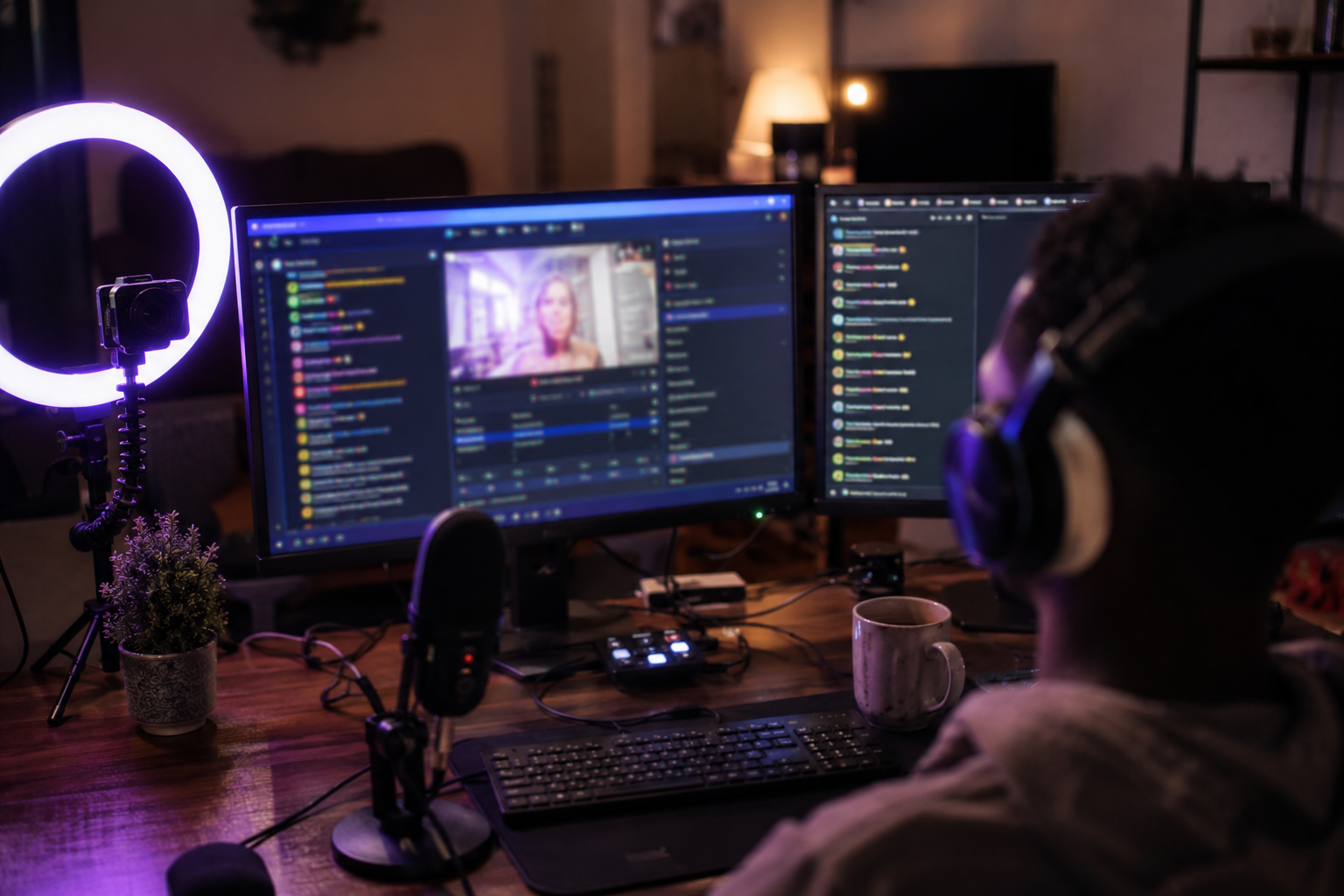
When Twitch quietly added a new toggle to its account settings in August 2026, most viewers scrolling through their privacy menu probably would have skimmed right past it. It sat near the bottom of the Security and Privacy tab, labeled simply “Training for Generative AI.” Yet within hours, that single switch had turned into one of the loudest conversations in the creator economy. Streamers filled chat with objections. Journalists picked up the story within a day. And a debate that had been simmering quietly across the internet for years, about who actually owns the value created when a person performs, talks, plays, or creates in front of a camera, suddenly had a very concrete and very public flashpoint.
The news itself is simple to describe. Amazon, which has owned Twitch since 2014, began using streamers’ broadcasts, video on demand recordings, clips, highlights, chat logs, and images to train its own generative AI systems. Twitch did not ask streamers to opt in. Instead, it gave them the ability to opt out, and only after facing pressure did it make that option publicly known. For a platform built entirely on the labor, personality, and creativity of millions of individual broadcasters, this was not a minor technical update. It was a decision about whose consent matters, whose labor generates value, and who gets to say no when a company built on top of your work decides to build something new out of it.
This article uses that moment as a starting point rather than an ending point. The headline event will fade from the news cycle within days, as headlines always do. What will not fade is the underlying pattern it exposes, one that touches every platform where people upload, perform, or create: the growing gap between the data economy that powers modern technology companies and the rights, awareness, and leverage of the people who actually generate that data. Understanding how this pattern works, why companies design settings the way they do, and what choices are available to creators and consumers alike is a piece of knowledge that will remain useful long after this particular controversy is forgotten.
In August 2026, Twitch added a new privacy setting that allows streamers to prevent Amazon from using their channel content, including live streams, video on demand, clips, highlights, chat text, and images, to train generative AI models that produce new text, audio, images, or video. The setting is off by default, meaning content is used for training unless a streamer actively turns the option off. Twitch executives, including Chief Product Officer Mike Minton and Head of Community Mary Kish, addressed the backlash directly in a livestream, acknowledging that an opt in system would see almost no participation and that the company did not expect users to be pleased with the arrangement. Twitch also clarified that the new toggle only covers training for generative models. Other AI powered features on the platform, including content moderation tools, recommendation systems, and creator monetization assistance, continue to use channel data regardless of how the new setting is configured. It remains unclear when Amazon’s use of Twitch content for AI training actually began, and executives said during the livestream that they could not confirm whether any individual streamer’s past content had already been used.
To understand why this moment generated so much reaction, it helps to look at where Twitch came from and how the relationship between platforms and creators has evolved over the past two decades.
Twitch launched in 2011 as a spinoff of the general purpose livestreaming site Justin.tv, built specifically around video game broadcasting. It grew quickly because it solved a problem that had never really existed before: gamers wanted to watch other gamers play in real time, chat with them, and feel like part of a community rather than a passive audience. That real time, personal, unscripted quality became the platform’s defining feature. Unlike a television broadcast or even a polished YouTube video, a Twitch stream captures hours of unfiltered human behavior, voice, reaction, and conversation. That raw, extended, and highly personal nature of the content is exactly what makes it so valuable for training AI systems today, though almost nobody thought about that possibility in 2011.
Amazon acquired Twitch in 2014 for roughly one billion dollars, a deal that at the time was mostly understood as Amazon buying its way into gaming culture and live entertainment, areas where it had struggled to gain traction on its own. For years, the relationship between Amazon and Twitch’s creator base was relatively distant. Amazon provided infrastructure, advertising relationships, and eventually integrations with Amazon Prime, but the day to day platform still felt like it belonged to its community of streamers.
That distance has narrowed considerably as Amazon has poured resources into building its own generative AI capabilities to compete with companies such as Google, Meta, and OpenAI. Large language models and generative video and audio systems require enormous amounts of training data, and the highest quality data is often the kind that is hardest to obtain cleanly: long form, spontaneous human speech, natural conversation, varied accents and speaking styles, and authentic emotional reactions. A platform like Twitch, with millions of hours of exactly that kind of content already sitting in Amazon’s own servers, represents an extraordinarily convenient and cost effective training resource. This is the broader industry context that explains why the opt out setting appeared when it did, even though Twitch itself never framed the announcement in those terms.
The pattern of platforms leveraging user generated content for AI training without clear upfront consent is not unique to Twitch. Similar controversies have played out across social media platforms, stock photography services, publishing companies, and cloud storage providers over the past several years, as generative AI companies have raced to secure training data faster than regulation, public awareness, or industry norms could catch up. Twitch’s situation stands out mainly because of how personal and continuous the content is. A photograph or a blog post is a discrete piece of work. A livestream is hours of a person’s unscripted voice, face, and personality, often recorded for years, which raises the emotional and ethical stakes considerably higher than in most previous data controversies.
At the center of this story sits a concept that touches nearly every digital service used today: the difference between data ownership and data usage rights. Most people assume that if they create something, whether that is a photo, a video, a piece of writing, or a livestream, they own it. In a narrow legal sense, that is often true. Copyright law generally grants the creator of an original work certain exclusive rights. But almost every platform a person uses requires them to accept a terms of service agreement, and buried within those agreements is typically a broad license that grants the platform (and often its parent companies and partners) the right to use, reproduce, modify, and in some cases sublicense that content for a wide range of purposes.
This is the mechanism that made the Twitch situation possible. Streamers technically retain ownership of their content, but by using the platform, they already granted Amazon broad rights to use that content in ways spelled out in the privacy notice and terms of service. Using content to train AI models fits within language that many platforms already had in place long before generative AI became a mainstream concern, because those agreements were written broadly enough to cover future uses that did not exist yet at the time they were signed. This is a critical lesson for anyone participating in the modern digital economy: contractual permission does not require specific foresight of every future use. A single broad grant of rights, agreed to years ago with a quick click, can end up covering technology and business models that did not even exist when the agreement was made.
A second concept worth understanding is the distinction between opt in and opt out consent models, and why companies overwhelmingly prefer the latter when it comes to data collection. An opt in model requires active, informed agreement before any data use begins. An opt out model assumes agreement by default and requires the user to take deliberate action to withdraw it. Behavioral research across many industries, not just technology, consistently shows that participation rates in opt out systems are dramatically higher than in opt in systems, simply because most people never change a default setting. Twitch’s own Chief Product Officer acknowledged this directly, telling viewers plainly that an opt in approach would see almost no participation at all. This single design choice, opt in versus opt out, is one of the most consequential and least visible decisions any platform makes, and it explains a huge amount of the friction between companies and users across the technology industry, from cookie tracking on websites to organ donation registries to retirement savings plans.
A third concept relevant here is the economic value of training data itself. In the earliest years of AI development, training data was often treated as a free, abundant resource, scraped broadly from the public internet with little regard for consent or compensation. As generative AI systems improved and became commercially valuable, the data used to train them became recognized as a genuine economic asset, not unlike raw materials in a traditional industry. High quality, diverse, and authentic human generated content has become scarce relative to demand, particularly as concerns grow about AI systems being trained on AI generated content, which tends to degrade quality over successive generations. This scarcity is precisely why platforms holding large repositories of authentic human content, whether that is Twitch’s livestreams, Reddit’s discussion threads, or stock photography libraries, have become strategically important to the companies that own or partner with them.
Understanding how the actual mechanics of this opt out setting function helps illustrate the broader system at work. When a streamer broadcasts on Twitch, the platform captures and stores that content across several categories: the live video and audio feed itself, any recorded video on demand version, shorter clips created by the streamer or viewers, highlight reels, chat logs from viewers interacting during the stream, and any images uploaded as part of the channel, such as profile art or overlays. Under the new setting, streamers can now instruct Amazon not to use any of these categories of content for training generative AI models going forward.
Importantly, the setting is narrowly scoped. It only prevents use in training models that generate new text, audio, images, or video, sometimes called generative or synthesis models. It does not prevent Amazon or Twitch from continuing to use a streamer’s content for other AI powered systems already built into the platform, such as AutoMod, the automated content moderation tool, or personalized recommendation systems that suggest streams to viewers. Twitch has explained that these systems are treated differently because they process content to perform a specific function in real time rather than retaining it to build entirely new models, and because disabling them individually could weaken safety protections for the broader community.
The setting is also not retroactive. Turning it on only prevents future use of content going forward. Anything that may have already been incorporated into Amazon’s model training prior to a streamer flipping the switch remains outside the streamer’s control, and notably, Twitch executives themselves said they did not know whether or when that earlier collection may have already occurred. This detail matters enormously for anyone trying to understand what this setting actually accomplishes. It offers control over the future. It offers no visibility or remedy for the past.
The most immediate impact of this change falls on Twitch’s creator community, but the ripple effects extend much further. For individual streamers, the central concern is a loss of control over a form of labor that is deeply personal. A livestream is not simply a product; for many streamers it functions as a diary, a performance, a source of income, and an extension of their identity. Learning that this material may be used to train systems that could someday generate synthetic voices, faces, or personalities resembling their own, without clear consent or compensation, understandably feels different from more abstract data privacy concerns like targeted advertising.
There is also a competitive dimension worth examining closely. Streaming is a business built on differentiation. A creator’s audience follows them specifically because of their unique voice, humor, commentary style, and personality. If AI systems trained partly on that content eventually make it easier to generate similar content synthetically, whether through AI generated commentary, synthetic voices, or automated highlight production, the competitive advantage that individual streamers have spent years building could be eroded by systems trained in part on their own work. This is not a hypothetical concern unique to Twitch. It mirrors debates happening in journalism, music, voice acting, and visual art, where creative professionals worry that AI systems trained on their body of work may eventually reduce the market value of that same work.
From a business strategy perspective, Twitch and Amazon’s decision also illustrates a tension that many technology companies now face: the need to balance aggressive AI development against the trust of the user base that generates the content those AI systems depend on. Amazon’s broader AI ambitions are significant, spanning cloud computing infrastructure, consumer devices, and increasingly its own large language models and generative systems. Twitch represents a valuable and somewhat unusual data source within that broader strategy because of its scale and its distinctly human, conversational nature. But if the backlash from creators damages goodwill, drives high profile streamers to competing platforms, or invites regulatory scrutiny, the short term data advantage could come at a longer term reputational cost. This is the classic tradeoff facing any company sitting on a valuable trove of user generated content: exploit it aggressively and risk alienating the community that produces it, or move cautiously and risk falling behind competitors willing to move faster.
There is a societal dimension as well. As more platforms adopt similar opt out defaults for AI training, the cumulative effect is a significant, largely invisible transfer of value from millions of individual creators to a small number of large technology companies. Most users will never open their privacy settings to find and disable these options, not because they approve of the practice, but because default settings are powerful and most people do not have the time, awareness, or technical inclination to audit every privacy toggle across every platform they use. Over time, this dynamic can concentrate enormous economic value, generated collectively by ordinary people, into the hands of the small number of companies with the infrastructure and legal position to claim it.
This is far from the first time a platform has faced this exact tension. Several prior situations help illustrate the broader pattern. Meta faced significant public criticism in the European Union over its plans to use Facebook and Instagram user content to train its AI systems, eventually adjusting its approach after regulatory pressure from European data protection authorities. Adobe built an entire marketing strategy around the opposite approach, promoting its Firefly AI models as trained only on licensed stock imagery and public domain content specifically to appeal to creative professionals wary of unlicensed AI training. Reddit signed licensing agreements with major AI companies to formally sell access to its discussion archives for training purposes, converting what had previously been an ambiguous gray area into an explicit commercial transaction, though individual Reddit users received no direct compensation from those deals. Getty Images pursued legal action against an AI image generation company over allegations of unauthorized use of its licensed photography for training purposes, a case that has become a significant reference point in ongoing legal debates about fair use and AI training data. Each of these examples reflects the same underlying question the Twitch situation raises: who controls the terms under which human generated content becomes fuel for AI systems, and who benefits financially when it does.
For individual creators and everyday internet users, several practical lessons emerge from this situation. The first is the importance of periodically reviewing privacy and data settings on every platform used regularly, rather than assuming defaults reflect personal preferences. Because opt out systems rely on inertia, the only reliable way to protect personal choices is to actively check settings rather than wait for a company to make the right decision automatically.
The second lesson concerns reading terms of service agreements with a longer time horizon in mind. It is easy to dismiss lengthy legal agreements as boilerplate, but the broad language in many of these documents is precisely what allows companies to apply old agreements to new technologies. Creators and businesses that rely on any platform for income or reputation should pay particular attention to clauses covering content licensing, data usage, and intellectual property, since those sections are the ones most likely to matter years down the road in ways that were not obvious at signup.
The third lesson is strategic rather than purely defensive. Creators, freelancers, and small businesses increasingly need to think about diversification the same way investors think about financial portfolios. Building an audience, brand, or income stream that depends entirely on a single platform means accepting that platform’s future decisions about data, algorithms, and monetization with very little leverage to negotiate. Creators who maintain an independent presence, whether through their own website, an email list, or a diversified set of platforms, retain more control over their long term position regardless of what any individual platform decides to do with their content.
The fourth lesson applies more broadly to consumers and businesses evaluating any digital service, not just streaming platforms. Understanding how a company’s revenue model relates to its use of user data is one of the clearest ways to predict how that company will behave in the future. A platform whose growth strategy increasingly depends on AI development, as is true across most large technology companies today, will naturally be incentivized to treat user generated content as a resource to be maximized, and users benefit from evaluating platforms with that incentive structure in mind rather than reacting only after a controversy becomes public.
Several trends are worth watching as this issue continues to develop. Regulatory attention to AI training data is intensifying in multiple jurisdictions, and it is likely that platforms will face growing legal pressure to adopt clearer, more specific consent mechanisms rather than relying on broad, decades old terms of service language to justify new AI training practices. The European Union’s data protection framework has already shaped how major platforms handle similar questions, and it would not be surprising to see similar regulatory pushes emerge in other regions as public awareness grows.
It is also likely that more platforms will begin offering explicit opt out or opt in AI training controls, following the pattern Twitch has now set, whether by choice or in response to competitive and regulatory pressure. Whether these controls trend toward opt in, which better protects user choice but reduces data collection substantially, or remain opt out, which protects the platform’s default access to data, will likely depend heavily on how much financial and reputational cost companies actually experience from public backlash like the one Twitch just faced.
Longer term, there is a reasonable chance that content licensing markets specifically for AI training will mature and formalize, similar to how Reddit and certain publishers have already begun striking direct licensing deals. If that trend continues, individual creators may eventually gain access to some form of compensation or negotiating power over how their content is used for AI training, rather than having that decision made entirely by the platforms that host their work. Creator advocacy groups and unions in fields such as voice acting and journalism have already begun pushing in this direction, and livestreaming platforms may eventually follow.
This story is ultimately less about one setting hidden inside Twitch’s account menu and more about a defining tension of the current technology era. Companies building AI systems need enormous amounts of authentic human generated content, and the people who create that content are often the last to be informed, let alone asked for permission, about how it gets used. The choice between opt in and opt out consent is not a minor technical detail. It is one of the most powerful and least visible levers companies use to shape user behavior at scale, and understanding that lever helps explain far more than just this one controversy. Creators, and really anyone active online, benefit from treating platform terms of service and privacy settings as living documents worth revisiting, not fine print to accept once and forget. And as AI training data becomes an increasingly valuable and increasingly contested resource, the question of who controls it, and who profits from it, is likely to remain one of the defining business and ethical debates of the years ahead.
What happened between Twitch and its streaming community in August 2026 will likely be remembered as one small episode within a much larger story that is still being written, the story of how modern economies decide who owns the value created by ordinary human activity once that activity becomes valuable training material for artificial intelligence. The specific toggle, the specific backlash, and even the specific companies involved will eventually fade from the headlines. What will remain relevant is the pattern underneath it: platforms hold enormous informational and structural power over the people who generate their most valuable asset, and default settings quietly decide outcomes that formal consent never truly addressed. For creators, businesses, and everyday users alike, the lasting lesson is not about Twitch specifically. It is about paying closer attention to the systems already shaping decisions on their behalf, long before those systems make headlines.